
Why Japanese Water Ionizers Cost More: The Technology Behind the Price
When consumers compare alkaline water ionizers, one question comes up again and again:
Why does a Japanese water ionizer cost ₹2–3 lakh when another ionizer is available for ₹50,000–₹80,000?
At first glance, the two machines may appear almost identical.
- Both may produce alkaline water.
- Both may produce hydrogen-rich water.
- Both may have multiple pH levels.
- Both may advertise titanium + Platinum electrodes.
- And both may show impressive hydrogen readings.
So why is there such a large difference in price?
Because you are not simply buying titanium, platinum, plastic and electronics. You are paying for the technology, engineering, safety, testing, certification and manufacturing expertise built into those materials.
And the biggest difference is often hidden where the consumer cannot see it:
Inside the electrolyser.
The Electrolyser Is the Heart of a Water Ionizer
A Alkaline water ionizer is an electrochemical appliance. The electrolyser is where the critical electrochemical process takes place.
The quality of its electrodes, coating, geometry, electrical control and water-flow management influences:
- Hydrogen, pH generation.
- Electrolysis efficiency.
- Electrode durability.
- Safe drinkable water output.
- Heat management.
- Mineral deposition.
- Long-term performance.
This is why comparing two ionizers simply by price, plate count or hydrogen output can be misleading.
The real technology is inside the machine.
“Titanium + Platinum” Does Not Mean Every Electrode Is the Same.
Many ionizers advertise:
“Titanium electrodes with platinum coating.”
But this tells you only the basic materials.
It does not tell you how the electrode is actually engineered.
You need to ask:
- How is the titanium surface prepared?
- What is the surface structure?
- How is the platinum applied?
- How uniform is the coating?
- How strongly is it bonded?
- What is the effective surface area?
- How is the electrical current distributed?
- How does the electrode perform after repeated electrolysis cycles?
- Is this your Proprietary manufactured or just commercially purchased from Alibaba?This is where Fujiiryoki’s electrode technology becomes particularly interesting.This article includes SEM images showing a finely irregular, highly structured titanium surface with relatively uniform platinum distribution. The comparison electrode shown in the same material has a different surface structure and an uneven island-pattern Pt-Ir coating.

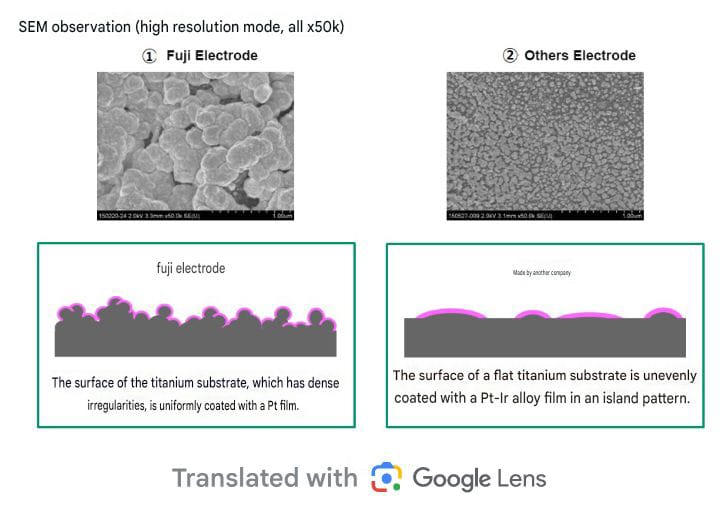
 SEM observation (high resolution mode, x50k) comparing dense uniform coating of fujiiryoki patented vs. island-pattern Pt-Ir film.
The point is simple:
“Platinum-coated titanium” is a material description. It is not a complete description of electrode technology.
Two electrodes can use the same basic materials and still have very different engineering.
Why Some Low-Cost Ionizers Can Show Higher Hydrogen Numbers
This is one of the most important points consumers need to understand.
The global OEM market (Like Chinese, Korean manufacturers of electrolysis) offers electrolytic cells and titanium electrode assemblies using different coating technologies, including platinum-coated titanium and ruthenium-iridium/MMO-coated titanium systems.
Some of these electrolysis technologies are widely used in (HHO generator /fuel cell) hydrogen gas-generation applications, where efficient gas generation is a primary design objective. Similar electrolytic cells are also marketed for alkaline-water and hydrogen-water equipment.
When a high-output electrolyser is incorporated into a drinking-water ionizer and operated under aggressive conditions, it can produce exceptionally high dissolved-hydrogen readings—potentially approaching or exceeding 2,000 ppb under particular test conditions.
That can make the lower-priced machine look technologically superior.
A consumer may reasonably ask:
“If this locally assembled machine produces 2,000 ppb and the Japanese machine produces 1,000–1,300 ppb, why should I pay more?”
The answer lies in understanding the design objective.
Think About a Racing Car vs. a Family Car
Consider two cars.
A racing car is engineered primarily for maximum performance on a racetrack. Its engine, cooling, transmission, suspension and other systems are optimized around speed and performance.
A family car has a different objective. It must balance performance with:
reliability, safety, comfort, efficiency, durability and everyday usability.
You would not judge the family car simply by asking which one has the highest top speed.
The same principle applies to electrolysers.
An electrolyser optimized primarily for commercial hydrogen or HHO generation can be designed to maximize gas-generation and produce a very high hydrogen reading.
A premium Safe to drinking water ionizer has a broader engineering objective:
controlled electrolysis + electrode durability + Medical Grade Safety + pH control + water-flow management + electrical control + consistent operation + long-term reliability.
So a higher hydrogen number does not automatically mean a better overall ionizer.
Different engineering objectives can produce different performance characteristics.
A Hydrogen Meter Measures Hydrogen—Not Engineering Quality
Hydrogen concentration is an important measurement.
But it is only one measurement.
A machine may produce: 800 ppb
Another: 1,200 ppb
Another: 2,000 ppb
The highest number may look impressive.
But what does the number actually tell you?
It tells you the measured dissolved hydrogen concentration under the particular conditions of that test.
It does not tell you:
- What electrode technology produced it
- What current was used
- What flow rate was used
- How much its electrolyser is Over-clocked?
- What the input-water conditions were
- How the measurement was performed
- How the electrolyser behaves after prolonged operation
A hydrogen meter measures hydrogen.
It does not measure the quality of the electrolyser.
That is why consumers should never evaluate a premium ionizer solely by its maximum hydrogen reading.
What About Ruthenium and Iridium?
Ruthenium- and iridium-based coatings, including MMO technologies ( Mixed Metal Oxide) are established electrochemical technologies and are used in different industrial and gas-generation applications.
The important question is:
What was that particular electrode system designed for, and what testing supports its use in the complete drinking-water ionizer?
International OEM marketplaces openly offer electrolytic cells using these technologies, including products marketed for hydrogen generation and alkaline-water applications.
This creates an important distinction.
A high-output electrolyser designed around gas generation can potentially be Installed into a drinking-water machine and deliver a very high hydrogen reading at very cheap cost.
But that number alone does not demonstrate that the complete machine has the same electrode engineering, long-term validation, control philosophy, manufacturing standards or certification framework as a purpose-built Japanese ionizer.
The application matters.
OEM Electrolysers vs. Proprietary Japanese Engineering.
The international OEM market makes it possible to purchase ready-made electrolytic cells and electrode assemblies and integrate them into low cost finished products.
This is a legitimate manufacturing model.
However, there is a fundamental difference between:
purchasing an existing electrolyser assembly and building a machine around it
and
engineering the electrode, electrolyser, power-control system as one integrated platform.
That is why consumers should ask:
Who actually manufactured the electrolyser inside this machine?
Not simply:
“Whose brand is on the front?”
If a product claims “Japanese technology,” ask what exactly is Japanese.
If it claims “Japanese electrode,” ask which Japanese manufacturer supplied it.
If it claims “medical-grade electrolyser,” ask what certification supports that claim and whether it applies to the complete product.
A logo or Japanese look alike brand name is not proof of manufacturing origin.
Fujiiryoki: Engineering the Complete Electrolysis System
This is where Fujiiryoki’s approach is different.
The HWP-77 is not simply designed around the number of plates.
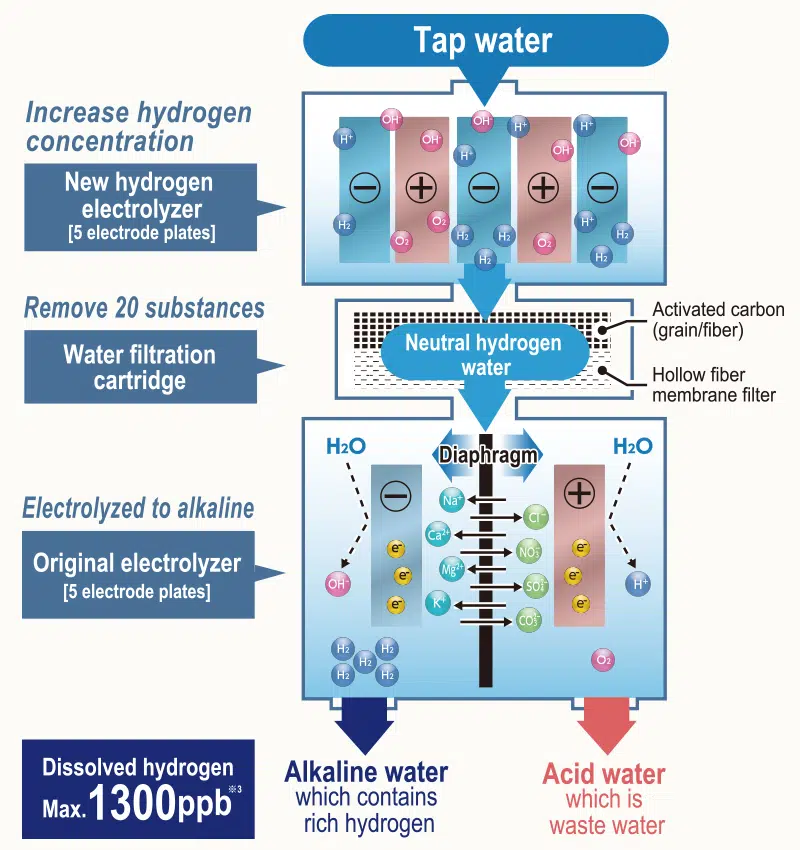
Fujiiryoki’s technical information describes a Patented dual-electrolyser architecture with 10 electrodes in a 5+5 configuration, together with advanced electrolysis control and platinum-coated titanium electrode technology.
The system is designed around the interaction of:
Electrode + electrolyser + electrical control + water flow + cleaning + filtration
The electrode is therefore not treated as an isolated commodity component.
It is part of the complete electrochemical system.
And Fuji medical’s technical documentation goes even deeper, examining the electrode surface at the microscopic level through SEM imaging.
That is the difference between simply specifying a material and engineering a component.
More Plates Do Not Automatically Mean Better Technology.
Another common marketing comparison is:
7 plates vs. 9 plates vs. 11 plates.
It sounds impressive.
But electrode count by itself does not determine the quality of electrolysis.
You also need to consider:
- Electrode surface area
- Electrode geometry
- Electrode spacing
- Surface structure
- Coating technology
- Current density
- Electrolyser architecture
- Water-flow rate
- Electrical control
- Cleaning system
A greater number of inexpensive electrodes does not automatically mean better electrolysis.
Count the engineering—not just the plates.
Why Does Japanese Manufacturing Cost More?
There is a simple analogy.
Suppose you buy 40 kg of ordinary iron or aluminum.
The raw material might cost only several thousand rupees.
Now consider an automobile engine weighing roughly the same amount.
That engine can cost ₹2–3 lakh or more.
Why?
Because you are not paying ₹2–3 lakh for the metal.
You are paying for:
- Metallurgy
- Engineering
- Precision manufacturing
- Tight tolerances
- Thermal management
- Safety engineering
- Testing
- Quality control
- Research and development
- Reliability
Exactly the same principle applies to a premium water ionizer.
You are not paying simply for the weight of titanium and platinum.
You are paying for what engineers have done with those materials.
The value is in:
- Electrode engineering
- Surface engineering
- Coating technology
- Electrolyser design
- Power electronics
- Control systems
- Water-flow management
- Testing & Certification
- drinking water level safety.
- Manufacturing precision
- Quality control
- Service infrastructure
Raw materials have a price.
Engineering has a value.
Safety, Certification and Accountability Also Have a Cost.
A sophisticated drinking-water appliance requires much more than the ability to generate hydrogen.
The manufacturer has to consider the complete system, including water-contact materials, electrical operation, electrochemical performance, manufacturing consistency and applicable certification requirements.
Research costs money.
Testing costs money.
Certification costs money.
Quality control costs money.
Precision manufacturing costs money.
Long-term technical support costs money.
These investments become part of the final product.
This is why comparing a ₹60,000 ionizer with a ₹2–3 lakh Japanese ionizer simply by looking at their external appearance or hydrogen output misses the most important part of the comparison.
Don’t Compare the Number. Compare What Produced the Number.
Before buying an ionizer, ask:
- Who manufactured the electrolyser?
- Where was it manufactured?
- What is the electrode construction?
- How is the coating applied?
- What is the surface structure?
- How is electrolysis current controlled?
- What testing has been performed?
- What certifications apply to the complete machine?
- Who will provide technical support and spare parts years from now?
These questions take the conversation away from marketing and into engineering.
Why Fujiiryoki Commands a Premium
Fujiiryoki’s premium positioning is not simply based on the words “Made in Japan.”
It is based on the engineering behind the product.
The HWP-77 combines:
- Japanese manufacturing
- Fuji Medical Instruments Mfg. Co., Ltd.
- Engineered titanium/platinum electrode technology
- Specialized electrode surface construction
- Patented dual-electrolyser architecture
- 10-electrode 5+5 configuration
- Advanced electrolysis control
- Automatic pH control
- Automatic cleaning
- Product testing and certification
- Manufacturer accountability
- Long-term service infrastructure
These are investments that cannot be measured by the weight of the machine or the number displayed on a hydrogen meter.
The Real Question Is Not “Why Is It More Expensive?”
The better question is:
“What am I paying for?”
If you compare only the visible features, a low-cost ionizer may appear to offer extraordinary value.
But when you look inside the machine, the comparison becomes very different.
You are no longer comparing only:
Price vs. price
or
Hydrogen ppm vs. hydrogen ppm
You are comparing:
- Commodity components vs. engineered components.
- Generic (commercial) electrolyser vs. proprietary electrolysis architecture.
- Maximum output vs. controlled electrolysis.
- Basic assembly vs. precision manufacturing.
- Specification claims vs. documented engineering.
- Short-term demonstration vs. long-term product design.
The Bottom Line
A lower-priced ionizer may produce alkaline Ionized water.
It may produce more hydrogen.
It may use titanium.
It may use a precious-metal coating.
It may even show 2,000 ppb or more under particular test conditions.
But a higher hydrogen reading does not automatically establish better overall technology.
Just as a racing car is designed for a different purpose than a family car, different electrolysers can be designed around different performance objectives.
And just as a 40 kg block of aluminum is nothing like a 40 kg precision-engineered automobile engine, the value of an ionizer cannot be determined by the amount of metal inside it.
The real value is in the engineering.
Look at:
- The electrode.
- The surface structure.
- The coating.
- The Safe Drinking water.
- The electrolyser architecture.
- The power-control system.
- The water-flow management.
- The manufacturing origin.
- The testing.
- The certification.
- The manufacturer.
- The service.
Because:
A piece of titanium with a coating is a component.
A precisely engineered electrolyser is technology.
And that is why a premium Japanese water ionizer can cost substantially more than a low-cost OEM or locally assembled machine.
Don’t compare only the hydrogen number or marketed features.
Compare the technology behind the number.
Fujiiryoki — Japanese Engineering. Japanese Manufacturing. Engineered Electrolysis.